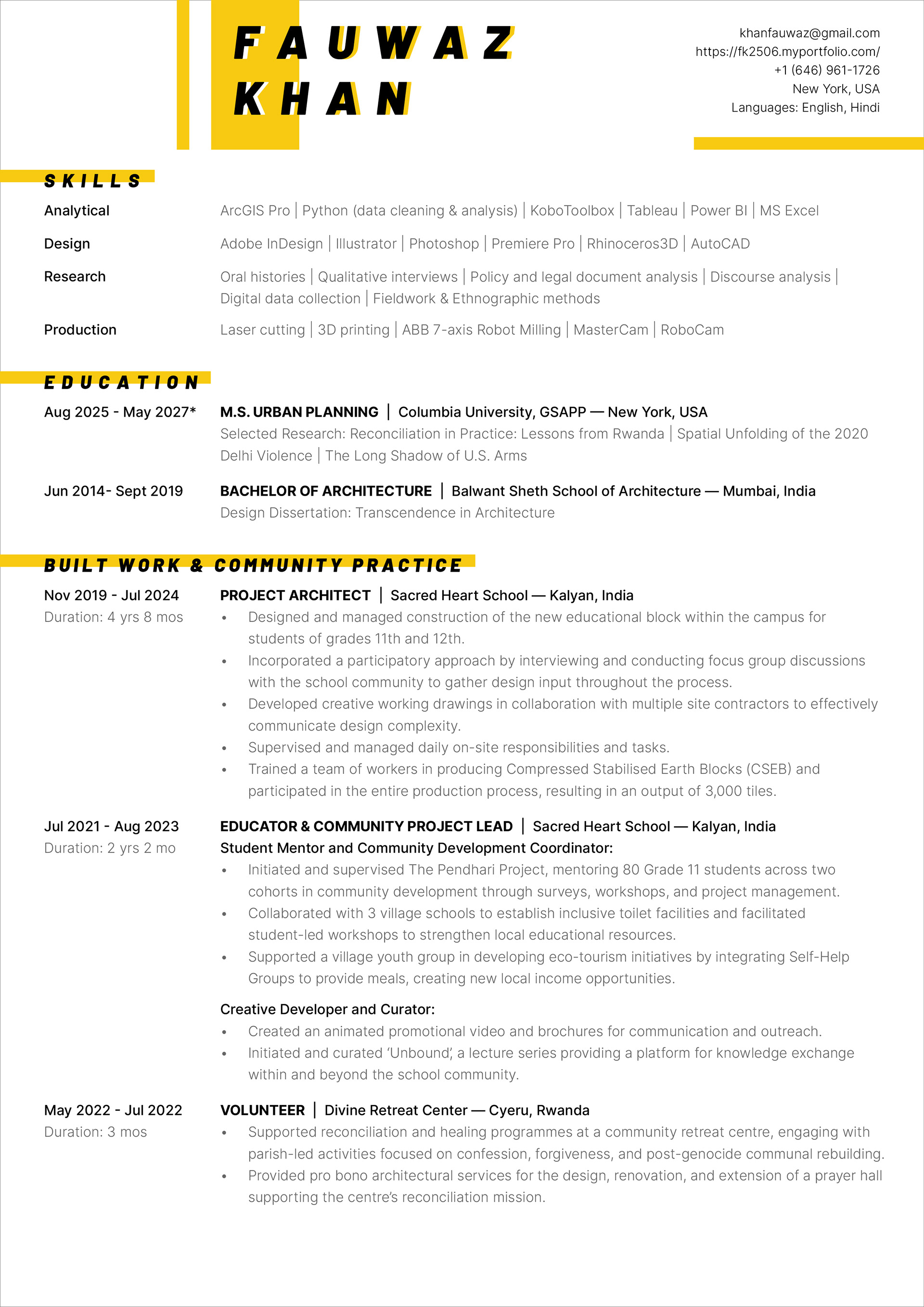
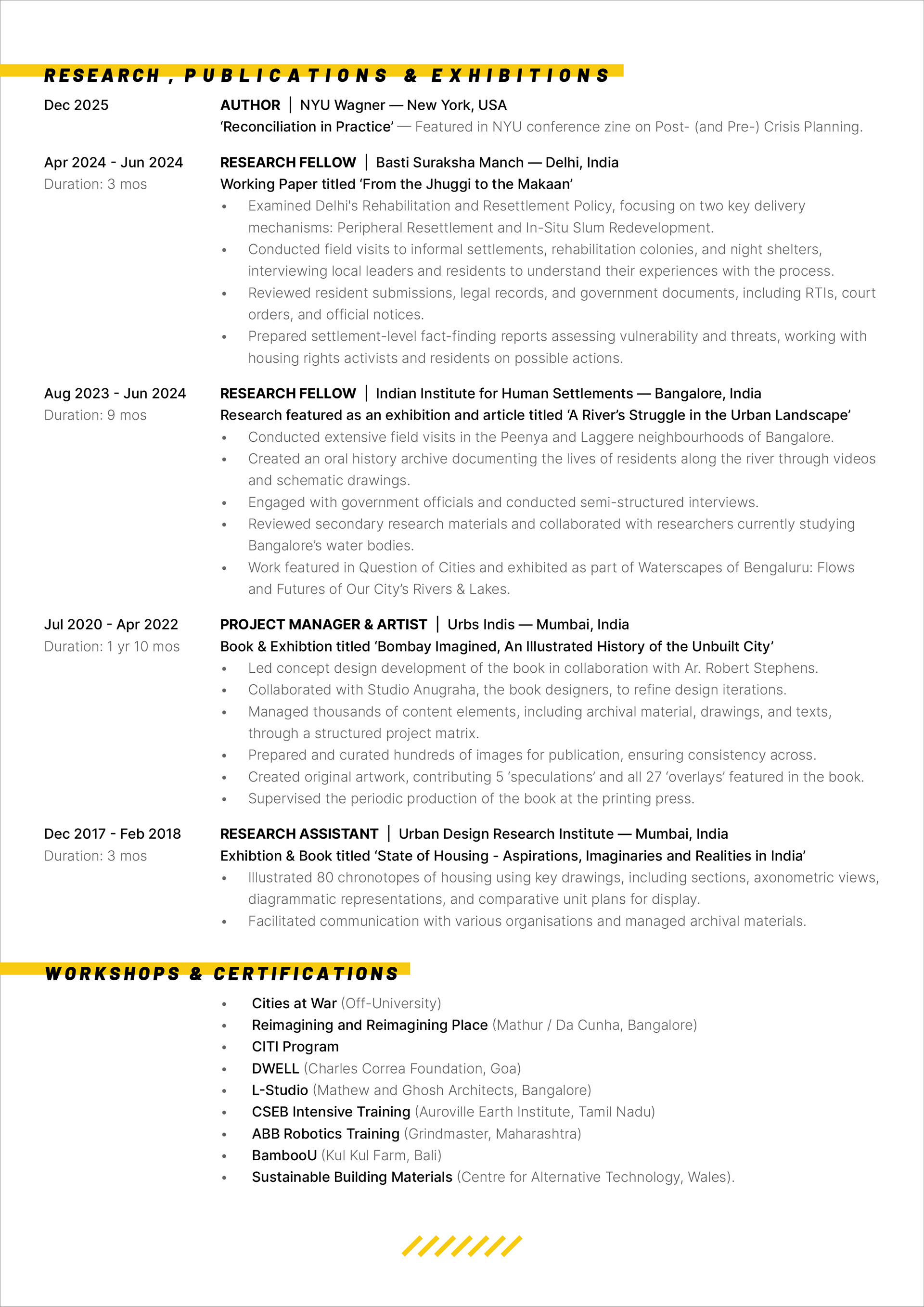
Fauwaz Khan is an interdisciplinary designer and researcher currently pursuing an M.S. in Urban Planning at Columbia University in New York. His work sits at the intersection of space, people, and stories, and grows from a curiosity about how cities are shaped not only through design and policy, but through lived experience, memory, and power.
Trained in architecture, his early encounters with building shaped an understanding of design grounded in process, learning, and ongoing negotiation. Working closely with people shifted his understanding of design toward collaboration, communication, and care. Over time, his work moved away from built form alone, engaging more closely with communities, policy, and research-informed practice.
A formative moment in this shift was his time at the Indian Institute for Human Settlements, where the urban itself became the classroom. Learning alongside anthropologists, lawyers, journalists, and policymakers shaped his understanding of the city as layered, contested, and deeply interdisciplinary.
He is interested in how knowledge is produced collectively, and places emphasis on positionality, bias, and ethics when working with people. Alongside this, he explores alternative forms of knowledge exchange through exhibitions, visual narratives, and community resources, viewing the urban as a space of learning beyond institutional settings.
His current research focuses on questions of conflict and on understanding the role of planning before, during, and after moments of violence. This interest was shaped in part by time spent in Rwanda, where he engaged with practices of communal healing and reconciliation. Across contexts, his work moves between fieldwork, mapping, archives, and narrative methods, with a focus on South Asia, West Asia, and Africa.
An Ode to Design* brings these strands together as an evolving archive of ways of thinking, making, and learning.